Here is the culmination essay I wrote for my Art Colloquium class in New York City. It (somewhat humorously) recounts what I did for two weeks in the city.
“New York, New York, If I can make it here, I can make it anywhere.”
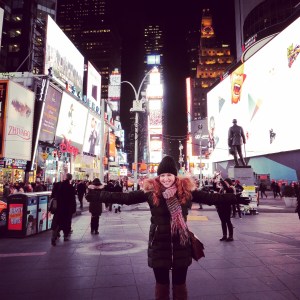 “These lights are so bright but they never blind me.”
I stepped off the plane at LGA airport, running off nothing but iced coffee with no idea what these next two weeks would bring. I was excited mostly, but also slightly intimidated. I picked up my luggage with resolve, got myself into a cab and finally to Hotel Beacon. I had a mission to accomplish. As a word minded woman, ignorant to the unknown world of art, I wanted to figure out: what was art and what did it mean?
I started this journey at the Modern Museum of Art (MoMA). This was probably the perfect place to begin as it had famous pieces that my non-art major mind could recognize like Van Gough’s Starry Night or Claude Monet’s Water Lilies or Picasso’s cubism works. Seeing such famous pieces in person almost felt like meeting a celebrity—you can’t believe it’s real and right in front of you. But, it is also much more ordinary than you would expect. That was half of my MoMA experience. The other half, I was disturbed, uncomfortable a nd reminded constantly of a class I took on experimental fiction. The art I’m referring to would be Robert Gober’s genital wallpaper, the video of a finger being repeatedly chopped off or the film of how to become invisible. The pieces left me feeling almost violated, but I knew I couldn’t un-see anything I had just seen. Experiencing what felt comfortable, known, and recognizable with the uncomfortable, the bizarre, and the very unknown made for a powerful juxtaposition that was beneficial in the end. Maybe it was good that these distinct styles yielded such different emotional responses. Art couldn’t possibly be only what I found appealing, I reasoned. And thus, day one of my journey was under my belt.
Day two was spent in the Metropolitan Museum of Art (the MET). What I saw, was moving, interesting, and imaginative. I began with the Egypt section, then headed to the Sackler Wing which I particularly enjoyed since it was in When Harry Met Sally. But I focused in the American Wing, particularly in the oil canvas portraits. Here I discovered what art I really liked and possibly even what art was. I loved looking at the faces of people, both the famous historical figures and the unknowns. I imagined what they were thinking at the time 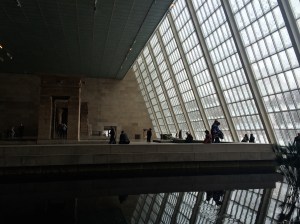 of the painting, imagined what their lives were like, what their problems were, who they loved—I was fascinated by their stories—by their lives. And, I mused that must be it: Art is how we put life into something tangible. Art is an attempt to show intangible human emotion. And for me, the art I was attracted to, had life in it, had people in it.
After the American Wing, I stumbled into the large room with the Christmas tree and tons and tons of sculptors of saints, Mary, and Jesus. I loved this area. Being Catholic, it was enriching to see so many beautiful, scared renditions of the saints I have learned so 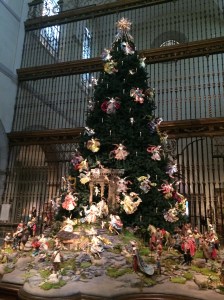 much about over the years. And it was here I made my next observation about the unknown world of art: religion is such a major part of the human experience that it is naturally tightly related and represented in art. Faith is an ultimate “intangible” so to speak. It’s believing without seeing. For me, it is a defining part of my life and it has been for many others throughout history. Almost everywhere I went during the trip, there was usually at least one piece that had some kind of religious significance. Religion being such a defining part of culture, it also helped me define art.
By Wednesday, I was on an art overdose. In all honesty, it was getting to be too much art for my non-art mind to handle. We went to several galleries on the Upper East Side and my “passionate” (perhaps impatient) side started to show. I saw a sculpture of a toothbrush and the only word I could think to describe it was—stupid. And I knew that wasn’t what I was supposed to think or feel. I was supposed to be having a deep, philosophical conversation in m y head, I was supposed to be figuring out what art was. Or appreciate how the common things can be made uncommon or beautiful. But staring at a lavender trapezoid in the Dominique Levy gallery, I couldn’t seem to get myself to have that conversation. By day three, I had felt moved by art, disturbed by art, and now annoyed by art. But, in every case: art was making me feel. Another way to define it—art forces a response, an interpretation.
After multiple galleries on the Upper East Side, we headed to the Guggenheim, and here I felt slightly more stimulated. I found the architecture of the building intriguing and different. There was also such a wide selection of styles that the different worlds coexisting in the white space was compelling. The Zero Movement was fascinating to me. Before seeing the exhibition, it had never occurred to me that the German art world would also need to rebuild and reinvent itself after World War II. Sotto’s piece with wires all over the place reminded me that humans are wired for struggle, but still beautiful just as the piece is. The Picasso pieces here I also liked much more than the ones at the MoMA. They were of people and once again I found life in them. In his Moulin de la Galette, I imagined who the girl in the red coat was. I fell in love with Edouard Vaillard’s Place Vintimille. The scene depicted and the detail  were incredible. After feeling annoyed earlier in the day, I was reinvigorated here.
And then came the Chelsea galleries… We began our day at the Rubin. First of all, the Hindu and Buddhist inspired art once again reinforced my definition of the tight link between art and religion. But, personally, this Asian art and culture has never been of much interest to me. I kept trying to feel something or have some kind of response, but I only felt disinterested. I blame this not on the works of art, but my particular interests. But this gave me something else to add to my definition: art depends almost entirely on who’s looking at it. “It’s not what you look at, but what you see.” -Henry David Thoreau. This couldn’t be more true. I brought my experiences, background, interests, knowledge, and opinions to every piece of art I looked at. The saints in the MET moved me, while the buddhas in the Rubin bored me. It’s not to say that one is “better” than the other. Rather, one reaches me deeper than the other. My classmates and I discussing our preferences showcased this as well: we all looked at the same works, yet we all saw something different. The rest of the Chelsea galleries we went to had few works in them and as a whole w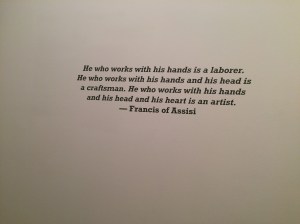 ere not my favorite. I did think the Hauser and Wirth gallery with the very large cream, moon-like structure was pretty amazing. It was called Moun Room by Thomas Houseago. As you walked through it, you felt like you were in another world. The woman working there said the artist dedicated it to his girlfriend which I found intriguing. I wondered about who and what inspires artists to create their pieces. It seems that often people inspire art. Returning to and reinforcing my earlier definition of art.
The next day we headed back to the Upper East Side to The Frick Collection. I absolutely loved this museum. I was fascinated by Henry Clay Frick, the original home owner. I loved his rich personal story and history and most especially his desire to have his home eventually become a museum. He was committed to collecting a diverse mix of work and to preserve not only art, but also history. Unlike many of the other galleries and museums we had se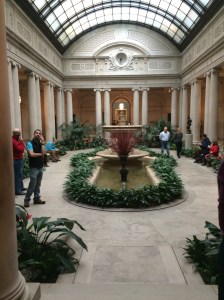 en before, this one was a personal home. This meant we were able to see works of art in their intended living environment. The difference created an entirely new feel than the other places had. I felt as if I were as house guest of Mr. Frick, rather than a tourist. Edith Wharton is one of my favorite novelist and spending time inside the Frick home, I felt as if I were in one of her novels. The house, the decorations, the architecture, the detail of every little vase to frame was incredible. The home’s grandiose feel made appreciating the art much easier and much more enjoyable. I closed my eyes when I was in Mr. Frick’s dining room and just imagined one of the many weekly dinner parties he held. I pictured the lives of the elite friends he must have had. I also had respect for a man who managed to leave behind such a huge legacy and such a selfless one at that. Looking at Henry Clay Frick’s portrait by J.C. Johansen, he definitely looks like a force to be reckoned with. The museum also had informational videos about Mr. Frick and one video called him, “an example of the American dream,” which I just thought was so powerful and inspiring. He was a self-made man and look at what he was able to do—so successful that he not only enjoyed the pleasure of art, but also allowed others to enjoy it for years to come.
The next day we had our class meeting. A few things were said that really hit me. “Art has no real reason for being, so what does it do? Why do we take care of it? Why is it important to us?” These questions were similar to the ones I began with. And these questions swirled around and around in my head.
On Sunday we visited The Cloisters. It was the perfect day to go, a bit cloudy, quiet, and the Lord’s day. I sat in the courtyard and just let the calm and peace come over me. I really wanted to be able to not only look at the art, but also enter into a conversation and prayer with God as I looked through this church-like space. The surrounding area doesn’t have much there. In fact, I jokingly called it a wasteland. I enjoyed comparing the Romanesque style with that of the Gothic style, noting the difference in the religious part as well. The first being more focused on avoiding the fires of hell, while the latter was more concerned with redemption. Finally I saw the famous Unicorn Tapestries. Disappointed isn’t the right word, because they were incredibly stunning, but I was expecting there to be more information about their origin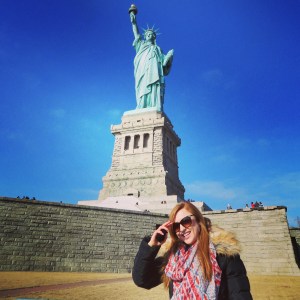 and their meaning. I am curious about the story behind them. But, maybe that’s the beauty of it…there isn’t one.
In our next class meeting, Professor brought up the point that there aren’t very many different ideas, merely different variations of the same several ideas. I pondered this and let it marinate in my mind. I thought back to something my classmate said while we were at the MoMA. He said sometimes it isn’t about the “skill” it does or doesn’t take to make something, but rather the idea or concept behind the work of art. This point would be to counter anyone who might say, “Well I could do that. What makes this so special? What makes this art?” I won’t go there, but I coupled his comment about it not being about the skill with Professor’s comment about it not being about a new epiphany or idea. I admit I was a little stumped–I found these conflicting. So if it isn’t about the idea, but about the different variation and that different variation isn’t skillful, then is it just “bad art?” I guess it depends on what you value– the idea of the piece or the skill of the piece.
After the class meeting with thoughts still swirling in my mind, we headed back to see more Chelsea galleries. We began in Lennon, Weinberg. Here we saw different kind of contemporary art. My favorite was a piece that simply said, “I know things and you’re wrong” in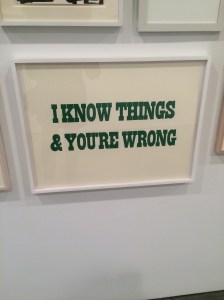 bold green writing. This just put a smile on my face as if the work is acknowledging how people may discount it or overlook it. And at the same time the work is making a true statement about so many of our personal lives. The truth is we all do know “things.” I also thought the piece sparked a discussion about how we interpret truth. Things aren’t true just because someone tells us they are. In other words, define yourself rather than being defined, remember you do know things, and have the strength to tell someone they don’t get to discount you.
In the same gallery there was another sketch that read, “Don’t worry your world isn’t falling apart It’s just being dismantled.” I wrote this in my journal and sketched the screws that accompanied the words. It just made me laugh. I enjoyed how it was sort of poking fun at pain and seeing the humor in bad situations. But, it was also hopeful, reminding people to keep going–they’re not totally broken. Then we headed to Marlborough which was very eclectic to say the least. It was full of sport inspired works, with space carpeting, a basketball court in one room, and Michael Jordan all over. The titles of the works were also very comical (also a bit profane). What I enjoyed most about this gallery was that it felt alive–fun.
Still in Chelsea we went to Winston Wachter. It was full of modern art that kind of r eminded me of melted crayon art. The piece that stuck out the most to me was a mirror that read “I am nobody Who are you?” I disagree. I believe everyone is someone and one of my favorite quotes is “Be somebody who make everybody feel like a somebody.” In other words how you make others feel about themselves say a lot about the kind of person you are. I strive to be the kind of person who uplifts. I probably did not fully understand the artist’s intent, but I didn’t like my interpretation. I prefer to make people feel important–remind them that they matter, as oppose to what the piece said. And then I began to wonder, does art seek to reveal more truth or does some art mask truth? I wasn’t sure.
We went to about ten or so galleries after this and I think I suffered from another “art overdose.” That was until we went to John Miller’s Here in the Real World. It finally felt like this collection captured what I had been thinking all along since the start of the trip. It brought my definition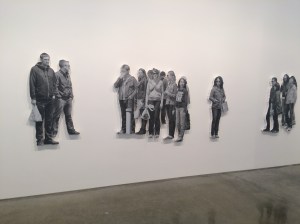 of art that I had been playing with to life–it was real people. There was a wall of large black and white cut outs of people doing everything from standing, waiting, talking to someone else, all the way to crying. It just felt like real life–real human beings doing the best they can at life everyday.
And then I started to wonder how many people I had passed in just one day in the city. How many lives, stories, problems, and people had I walked by? It occurred to me that New York City is a smorgasbord of living art—living masterpieces. That’s why “Humans of New York” has been so successful. Art always comes back to people. And art has room for all of us. That’s why it isn’t always “just pretty.” Sometimes it’s disturbing, dark, satirical, poignant, silly, or any number of things. And it speaks differently to everyone.
One of my favorite hobbies is running. I couldn’t wait to be able to run through New York City. Finally on Wednesday (and then again two more times) I bundled up and decided to brave the cold and get my run in. Before my run I still didn’t know what I was going to write my essay about. I felt intimidated being a non-art major, knowing very little about art, and having no formal art training. I also felt discouraged that maybe I wasn’t looking at pieces correctly or interpreting them in the right way. I worried that I wasn’t going to be inspired. And then I ran. And I ran through Central Park, though the Upper East Side, around the Jacqueline Kennedy Onassis Reservoir, ran to the Upper West Side, ran to Columbia University, and I realized what I missing. I am inspired by the view of the skyline across from the Reservoir, by the people riding in the horse-drawn carriages, by the other runners, by the couples walking, by the moms pushing strollers, by the crumpled snow, by the trees, by the ice skaters, by the nature inside Central Park nestled into this enormous city. I am inspired by the delicious smells of Leavin Bakery and the gross smells of I-don’t-want-to-know-what, the horns, the cars, the wind the subway creates as it passes by, the nonstop movement, the way Times Square feels like a party, the music and dancing found on street corners and subway tunnels, the way yo u hear at least five different languages and accents on any given day, the random comments and exchanges you have with complete strangers, the woman running after a man who dropped his credit card outside of Starbucks–it might sound cheesy or cliche, but I fell in love with all of it. And as I blasted my music and ran past it all–it hit me. I knew what I was going to write about. Professor asked us to compare works of art, so I compared the rats of the subway with the disturbing work of Robert Gober at the MoMA. To me, while both gross, each have a natural place and have found their place. (And isn’t that what life is about?) I compared the couple walking hand in hand in Central Park with the serenity found in the eyes of Lady Agnew of Lochnaw in the Frick Collection. I mentally compared each work of art with the very real people living outside of the walls of the museums and the galleries.
Even though this essay has dragged on it hasn’t even scratched the surface of everything I saw, experienced, and felt. I was able to eat and eat and eat lots of “New York style” cuisine. I saw the Museum of Natural History, the Museum and Library of J.P. Morgan, the Statue of Liberty, Ellis Island, the view from the top of the Empire State Building, Times Square, Brooklyn Bridge, a show on Broadway, Grand Central Station, Washington Square Arch and Park, the One World Trade Center, 9/11 Memorial, Soho, Greenwich Village, West Village, Teacher’s College, the High Line, Little Italy, Chinatown, the Upper  East Side, the Upper West Side and so much more. I could easily write an entire essay about each one of these because every second in this magnificent city was awe-inspiring. And each place held a different view, a different way of life, and always a new adventure. I am different, forever altered, from simply breathing the New York air.
I’m not an art major so I may not be able to compare specific styles or techniques of art or speak fluently about different artists. (I hate to disappoint) But I am a journalist and a writer. I know people. I know stories. And after two amazing, life changing weeks in New York City I think I have an idea of what art is…a person’s best attempt to put life into a tangible work–to give meaning to the meaningless, to stretch boundaries, to beg responses, to evoke emotions and to leave behind something that wasn’t there before.
And I realized that’s exactly what I attempt to do with my writing. So maybe I wasn’t so ignorant to the art world after all.
 Mallory McDonald